Everything you should know about storing liquefied natural ...
Everything you should know about storing liquefied natural ...
Liquified natural gas is projected to become a key source of energy in the coming decades. Propelled by its undeniable advantages (it's the cleanest fossil fuel, abundant and complements renewable energy sources), LNG is redefining the market as it helps provide energy during demand peaks for a global scenario.
The company is the world’s best Lng Cryogenic Storage Tank supplier. We are your one-stop shop for all needs. Our staff are highly-specialized and will help you find the product you need.
Find out what LNG gas is exactly, what uses does this liquified gas present, and what type of LNG tank is the best to store it.
What is LNG?
Liquefied natural gas (also known as LNG) is natural gas cooled to a liquid state for the purpose of easier storage and transportation.
When natural gas reaches about -260° Fahrenheit, through a liquefaction process using cryogenic heat exchangers, it becomes 600 times smaller than natural gas. This facilitates its management and has become its main advantage.
While its liquefaction process was developed in the 19th century, it's today's uses of liquefied natural gas that have boosted this element. Thanks to this process, it's easier to transport LNG through long distances (for instance, from the U.S.A to South Korea) without using gas pipelines, which are not feasible in such cases.
Demand for LNG has grown over the past years and is expected to continue growing. For instance, U.S. exports of liquefied natural gas continued to grow in the first six months of , at an average that marks an increase of 42%, or 2.8 Bcf/d, compared with the same period in (following figures by the U.S. Department of Energy's LNG Monthly).
The main advantages of liquefied natural gas include:
- Vast resources at a global scale compared to other fossil fuels
- The capacity to easily distribute and store it, facilitating having access to it whenever patterns of demand shift.
- A greener option compared to other fossil fuels, generating cleaner burning than other alternatives.
Main uses of liquefied natural gas
The main use of liquified natural gas consists of its power as an energy supply.
energy supply for the following scenarios:
- Domestic heating. Liquefied natural gas has become the right answer for peak consumer demands above normal parameters.
- The industrial sector uses LNG as fuel for manufacturing diverse items such as electronic devices, fabrics, pharmaceutical products or plastics, among many others.
- The transportation sector is beginning to consider LNG as an alternative to petrol.
Storing liquefied natural gas
LNG is a clear and non-corrosive liquid which weighs less than water and is made up of at least 85% methane. It presents several characteristics that must be taken into account when looking for storage alternatives.
Different containers and its characteristics
In order to store it, the right LNG tank is needed, using cryogenic technology to guarantee its optimal and safe storage until LNG is needed.
These systems usually include above-ground, low-pressure tanks (less than 10 kilopascals), with double walls for enhanced protection and a vacuum that provides thermal insulation and thus maintains the cold temperatures needed. All in all, small amounts of heat enter the system and must be safely removed periodically.
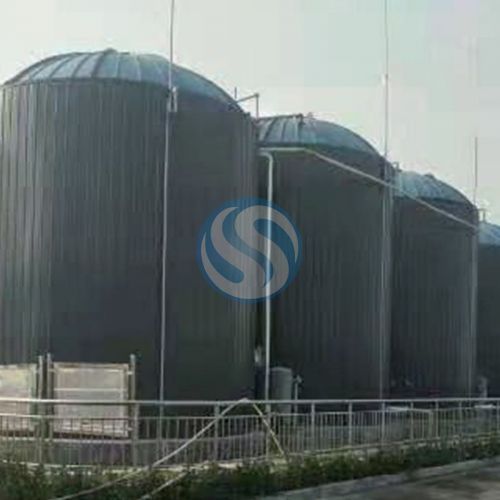
Typically, an LNG tank can have a capacity ranging from 1,000 to 30,000 m³. The bigger tanks present a cylindrical shape with a domed roof, while smaller versions may be stored in both horizontal or vertical pressure vessels, where pressure may range from less than 50 to over 1,700 kPa (7.3'246.6 psi).
Today, an additional high-nickel steel wall or an outer tank made of concrete are often added to provide extra containment.
Cryospain's role
Cryospain provides the expertise and technical knowledge to design and implement flat bottom cryogenic tanks for LNG storage.
We design our gas storage tanks with double-wall steel structures using high tech insulating materials (cellular glass, expanded perlite, rockwool, etc.).
All the cryogenic storage equipment we produce complies with the most recognized quality and safety certificates on an international level. Our standards include:
- Mechanical and seismic design: API620, API650, ASME and EN, EN, EUROCODE
- External access: EN ISO-1/3 and OSHA .23/24
- Other regulations including EIGA/CGA/127/13/E and NFPA 59A
Regarding liquefied natural gas, a recent success story in Santa Cruz de la Sierra, (Bolivia) highlights our role as trusted partners.
Additional reading:4 Tips for Choosing a Cryogenic CO2 Storage Tank
The Advantages of Implementing Plating Waste Treatment
How to Choose a Laser Tube Cutting Machine?
Maximize Precision with a Laser Tube Cutting Machine
Everything You Need To Know To Find The Best Castor Oil Machine price
The Advantages of Implementing Solar Energy Solutions
The Advantages of Implementing Automated Packaging Solutions
Want more information on Customizable Lng Low Temperature Storage Tank? Feel free to contact us.
This project was both extremely challenging on many levels and hugely gratifying in terms of the benefits it has brought to the area.
This Flat-Bottom Cryogenic Tank is for the storage of Liquid Natural Gas (LNG). This type of installation is known as a 'virtual pipeline'. It consists of liquefying natural gas for liquid distribution in areas where it is difficult to install a pipeline network.
The main issue that made our task more daunting was the location itself: deep in the jungle, high in the mountains, far from any urban centres and difficult to access. It was also challenging to find qualified workers in the area. Added to that was the task of building a base camp in the jungle, where heat and rain were constant obstacles.
Transport was also a huge logistical challenge. Parts could not be sent gradually so over 25 containers from all over Spain had to be put on one ship. Not only that, Bolivia has no port, meaning two customs processes, one in Bolivia, but prior to that another upon entry into neighbouring Chile. Getting the trucks to the site wasn't easy either, given the nature of the terrain.
The project was a success, however, both for our clients and for the environment, allowing access to natural gas to many citizens who have opted to make the switch from heavy hydrocarbons (fuel oil, diesel) to natural gas.
All in all, a challenging project that became a success that benefited both our satisfied customer as well as the local environment.
Want to learn more about LNG and its storage possibilities? Discover our Reference list for cryogenic tanks.
LNG Cryogenic Storage Tanks
At present, the LNG cryogenic storage tanks commonly used at home and abroad have three methods: atmospheric pressure storage, pressure storage of daughter tanks and pressure storage of vacuum tanks. Which storage method is used depends mainly on the amount of storage.
1.Low Temperature Atmospheric Pressure Tank
The structure of the atmospheric tank includes bimetal tanks, and the outer tank adopts prestressed concrete structure; there are above-ground tanks and underground tanks, and most of them below 20,000m³ are bimetal tanks.
The inner and outer tanks of the atmospheric tank are installed and manufactured on site, and the production cycle is long.
The operating pressure of the LNG low temperature and atmospheric storage tank is 15KPa and the operating temperature is -162 ° C. It is a flat-bottomed double-walled tank. The tank body is composed of two layers, the inside and the outside, with a heat-insulating structure and a cold-keeping layer. The inner tank is used to store liquefied natural gas, while the outer shell is used to protect and keep cold. In order to reduce the introduction of external heat into the tank, the inner and outer tanks are designed to be separate and independent. The tank item is a self-supporting vault. The inner tank item must have sufficient strength and stability to withstand the external pressure caused by the cold insulation material and the internal pressure generated by the internal gas.
The storage tank adopts pearlescent sand as the cold insulation material and is filled with dry nitrogen to ensure the micro-positive pressure of the interlayer, the thermal insulation material is isolated from the atmosphere, avoiding the influence of atmospheric pressure or temperature changes, and the humid air entering the cold insulation layer between the inner and outer tanks. The service life of the cold insulation material is effectively guaranteed and the use effect of the cold insulation material is effectively guaranteed and improved. When designing and manufacturing thermal insulation structures, care must be taken to prevent moisture.
Through technical and economic comparisons, the one-time investment of the low-temperature and atmospheric-pressure storage tank scheme is lower than that of the mother-and-son tank scheme, but the operating cost of the low-temperature and atmospheric-pressure storage tank scheme is much higher than that of the mother-and-son tank scheme.
Features of our Low Temperature Atmospheric Pressure Tank
- Adiabatic method: adiabatic powder accumulation
- Effective volume: m³ ' 50,m³
- Working pressure: 10k Pa ' 50k Pa
- Storage medium: LNG, liquid ethylene, etc.
- Structural characteristics: vertical, flat bottom, suspended ceiling, double-walled, all-inclusive structure with thermal angle protection
- Foundation type: concrete foundation overhead
2. LNG Mother and Child Tank
The inner tank of the mother tank is a plurality of low temperature resistant stainless steel pressure vessels. The outer tank is a large carbon steel container covered by multiple inner tanks. The inner and outer tanks are also filled with thermal insulation material. The interlayer is filled with dry nitrogen to prevent moisture. Air enters. The inner tanks of the mother and child tanks are manufactured at the factory and transported to the site after pressure testing, and the outer tanks are installed on site.
Storage and distribution stations with a storage scale of m³ to m³, can choose the mother-tank or atmospheric tank for storage according to the situation. Due to the requirements of internal tank transportation, the maximum domestic single-tank can reach 250m³. The process is roughly the same as the vacuum tank. Because the interlayer requires nitrogen, an additional liquid nitrogen device is added to the device.
Features of our LNG Mother and Child Tank
- Effective volume: 600m³ ~ m³
- Working pressure: 0.3MPa ~ 1.0MPa
- Adiabatic method: pearlite sand powder accumulation insulation & slightly positive pressure dry nitrogen
- Medium: liquid oxygen, liquid nitrogen, liquid argon, LNG, liquid ethylene, etc.
3. LNG Vacuum Storage Tank
The LNG Vacuum Tank is a double-layer metal tank, the inner tank is a low-temperature-resistant stainless steel pressure vessel, the outer tank is made of carbon steel, the interlayer is filled with thermal insulation material, and the vacuum is evacuated. The vacuum tank is transported to the site as a whole after the factory pressure test is completed.
The total storage capacity of LNG is below m³. Generally, multiple vacuum tanks are used for centralized storage. At present, the maximum volume of a single vacuum tank in China is 150m³. The process of the vacuum tank is relatively simple. Generally, a pressure booster is used to pressurize the storage tank. The material flows by pressure into the gasifier without using power equipment. The energy consumption is low. Therefore, small domestic and foreign LNG gasification stations basically use vacuum Pot form.
For more information, please visit Liquid Oxygen Micro Bulk Storage Tank.
How to Choose a Laser Welding Machine for Battery Packs?
Laser Welding Machine vs Traditional Methods: Battery Pack Solutions
How to Compare Shea Butter Extraction Machine Prices?
How Does the CBD oil extraction machine price Work?
Things to Consider While Choosing the Right Excavator
Mechanical Pulverization: 5 Key Benefits You Should Know